
 (+34) 93 57 95 415
  Request Information


Polarization
Polarization is the property that all transverse waves possess that produces a vibration of these with more than one orientation. We can find the direct and the reverse.
Direct polarization occurs when the positive connection (+) is connected to the anode and the negative connection (-) to the cathode. On the other hand, the terminal (+) must be superior to the terminal (-). The external voltage of this direct property is due to the fusion of P and N. More specifically to the negative connection to the type N semiconductor and the positive connection to the semiconductor P. This has a reduced barrier potential, a higher direct current, and a lower resistance than the reverse.
Reverse polarization has the negative terminal in zone P, while it has the positive terminal in zone N. Unlike reverse polarization, it has a strong barrier potential, a lower direct current, and higher resistance.
Methods to measure it
The methods to measure the polarization of light are
The one of reflection: which occurs at the moment in which natural light penetrates the surface that is in the separation between two media.
You dare the dispersion: it happens when the waves radiate and disperse at the moment when the light passes through the material.
The refractive one: happens when the ray of light passes through two means.
Transmission: employs polaroid filters, which have the function of blocking magnetic and electrical waves.
Types of polarization
We can find different types of polarization depending on the mismatch they find
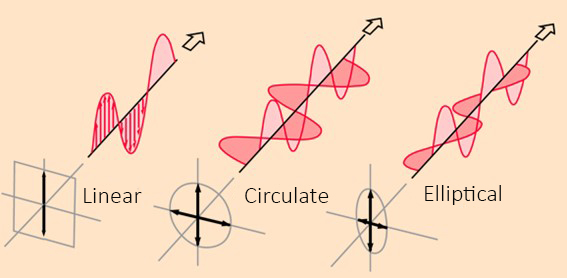
Elliptical: it has waves that are displaced by an ellipse-shaped trajectory.
Linear: the frequencies move in the same plane temporarily. Within this polarization we can find:
Horizontal: Its wave electric field is horizontal to the Earth’s surface.
Vertical: has an electric wave field perpendicular to the surface.
Circular: their frequencies move by rotating on their axis. Within this classification,we can find:
Dextrogira: its rotating movement is towards the right.
Levógira: its rotating movement is towards the left.
Polarization can be applied in several applications. However, the most frequent are: to differentiate transverse and longitudinal waves and for infrared spectroscopy.